

Cruise Itinerary
| Date | Activity | Arrive | Depart |
|---|---|---|---|
| 12 Jan 2028 | Cochin (Kochi), India |
Transfer to Pallippuram | |
| 12 Jan 2028 | River Village |
Pallippuram | Embark Cruise |
| 12 Jan 2028 | Vaikom, Kerala, India |
||
| 13 Jan 2028 | Chenganda, Kerala, India |
||
| 13 Jan 2028 | River Village |
Kumarakom | |
| 14 Jan 2028 | Kavalam, Kerala, India |
||
| 15 Jan 2028 | Kainakari, Kerala, India |
||
| 15 Jan 2028 | River Village |
Pulinkunnu | |
| 16 Jan 2028 | Champakkulam, Kerala, India |
||
| 16 Jan 2028 | Changankari, Kerala, India |
||
| 17 Jan 2028 | Thottappalli, Kerala, India |
||
| 18 Jan 2028 | Karumadi, Kerala, India |
||
| 18 Jan 2028 | Kanjippadom, Kerala, India |
||
| 19 Jan 2028 | Alleppey, Kerala, India |
Disembark at Punnamada |
All itineraries and ports of call at the discretion of the cruise line subject to local weather conditions and may change without notice.
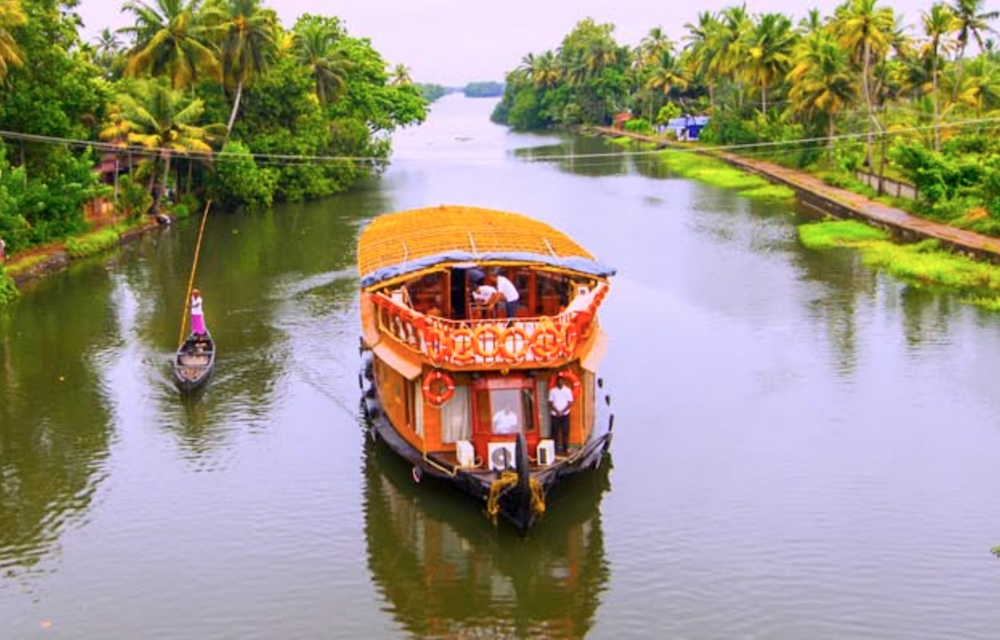
The river cruise takes you through wide lakes, flowing rivers, narrow canals and tranquil lakes with many villages on its banks that are only connected by water. Life is all on these waterways with people commuting in wooden dugout canoes where school children, traders and fishermen all mingle together to make the voyage through the bustling waters both colourful and very exciting.
Visit temples, churches, market places, traditional dance and martial art schools and ayurvedic medicine centres. Meet the elephants of Kerala and take a canoe ride through the Kumarakom Bird Sanctuary. Experience how coir making is done and how, traditional wooden boats are built by stitching the planks of wood together with coir rope. A really delightfully tropical river cruise on warm waters with a lot of sun bathing and lazing as you sail towering twenty feet above the paddy fields in canals held together by dykes or, along the Arabian Sea where the setting sun splashes the endless waters with a bright orange glow.
Day 1: Cochin, Pallippuram – Vaikom
Transfer from the hotel in Cochin to the embarkation jetty at the ancient village ‘Pallippuram’, at the southern border of Cochin. Enroute, we visit a Kalari – the traditional training centre for authentic Martial art (Kalarippayattu). Kalarippayattu in Kerala has its origin from the ancient Indian scripture, Dhanur Veda.
This training helps to understand the 107 energy points in human body, learn the practices to maintain the normal flow of the energy and to heal ailments by Marma therapy. The exercises help to gain stamina, flexibility, calibrated functioning of body and mind, and quick reflexes required for self-protection.
The south-west corner of a Kalari houses the guardian deity of the Kalari. The seven tiers symbolise the seven abilities that each person must possess: Strength, Patience, Power to command, the posture, the expression and the Sound. Flowers, incense and water are offered to the deity every day. Before starting the day’s practice, it is the norm for practitioners to pray to the deity. There is also a Guruthara inside all Kalari, where a lamp is kept burning in reverence to all the gurus (masters) of the Kalari.
After the performance, we drive to the embarkation jetty near the filial church of ST. Thomas – 2ND AD, Pallippuram. Our welcoming team on-board will help you with smooth check-in, give a briefing about the facilities on-board the safety measures to be familiar with. Relish the Sadya, the traditional freshly cooked complete meal served on clean Banana leaf. Unwind as the boat leaves behind the bustling township and cruises gently to the remote villages. By evening we arrive at the ancient pilgrim town Vaikom and drop anchor.
Take a short walk to the local cultural centre to watch Kathakali, the traditional dramatic and mimetic dance form, which plays stories from the epics. It is a unique blend of dance, music, action, literature and make-up.
Take a short tuk-tuk ride to the ancient temple. The town is centered at the ancient temple of Lord Shiva. This town made an indelible mark in the history of Casteism in Kerala, when the feudal ban on underprivileged communities from entering temples and their premises was abolished due to a massive protest of the public. This incident had set in motion the social reformation in Kerala.
The architecture of the temples in Kerala is based on ancient science of construction and geographical features of the land.
As per the traditional architecture, each element of temple represents an element of human body and, a temple is not only the space for spiritual enlightenment but also the venue for harmonious social networking. Even the devotees from far off places come all the way down to Vaikom for ritualistic ceremonies such as the first meal of babies, marriage and thanks giving offers such as meal for the poor, cultural performances and specific rituals prescribed by the Veda.
After watching the ritual by sunset, we return to boat and relax. (The pompous 12-days’ long annual festival of this temple is vibrant with ancient Vedic rituals and cultural performances of devotees.)
Return to the boat and relax.
Day 2: Vaikom – Chenganda – Kumarakom
After breakfast the cruise resumes.
While cruising there will be a talk by a Physician on traditional Ayurveda.
One of the insightful visits of the day is the laid-back village – Chenganda, the hub of coir spinners and weavers and bio concrete producers. Coir is one of the major exports of Kerala. The Coir industry is a cottage industry that provides livelihood for inhabitants of rural villages along the Backwaters. It is A strong rope made by spinning the organically softened fibre of Coconut husk. Because of the strength of the rope and high resistance to water and salinity, Coir is being used for weaving carpets, geo-textile for soil erosion and green houses, orthopedic mattresses, boat building and for lifting mighty fishing nets which dot along the Backwaters. Coir is of much more relevance today than ever before when plastic has become a global menace. Chenganda is the major centre of this cottage industry. Explore the riparian life, where men venture into the waters to collect clams. Various preparations with the meat are delicacies of the region. The shells are recycled to produce sustainable bio concrete.
Return to our boat and cruise to Thanneermukkom.
Cruise to Thanneermukkom. The barrage at Thanneermukkom built across Vembanad to contorl the inflow of perennial salty water and the outflow of the fresh water enriched by rivers.
Relax on the boat, enjoying the soothing breeze and the exuberance around.
This afternoon, we visit the house of a Syrian Christian family for a home hosted lunch. This house is located on an island which was made by the men of the house, by reclaiming land from the lake. The welcoming hostess take you through the various stages of preparation of traditional Syrian Christian cuisine. You may also try your hand at cooking and listen to the story of her family, of three generations of laborious men, and equally strong women who supported their pioneering spirit. After relishing the lunch, enjoy a walk exploring the vegetables, local vegetation and fish farming. We continue the cruise till sunset.
Day 3: Kumarakom – Kavalam
By early morning, we set out by country boat to explore the migratory and endemic birds of Kumarakom, which is a cluster of lagoons of Vembanad wetland eco-system at the backdrop of mangroves, paddy fields and coconut groves. It is home to. Terns, Grey headed swamphen, purple heron, Grey heron, Pond heron, Kingfisher, Blue tailed bee eater, Open bill stork, Egrets, Cormorants, Oriental darter, Pink headed warbler, Indian cormorant/Shag, Brown headed gull, Osprey, Swallow, Water snake (checkered keelback), White throated kingfisher, Crow pheasant or Indian coucal Lesser whistling ducks.
Return to the boat, refresh, and have breakfast.
Cruise on the majestic Lake -Vembanad, the confluence of 4 major rivers before they drain into the Arabian Sea.
We arrive in Kavalam village by evening where river ‘Pampa’ reverses its course and drains into Lake. You may take the ferry to explore the region, walk along the dykes surrounding the expanses of paddy fields and interact with the farmers and members of ‘Kudumbha shree’ -women’s collective for women empowerment and poverty alleviation in rural villages.
The cruise continues till dusk, taking us through the remote interiors of Kavalam. Kavalam is famous for its rich cultural heritage. This evening, we will watch Mohini atom and Bharatha Natyam performance.
Day 4: Kavalam – Kainakari – Pulinkunnu
After breakfast we set sail through the interiors of Kuttanad- the regions below sea level. We cruise to Kainakari village and explore the narrow remote canals by country boat, watching up close the laid-back, yet harmonious, life along the way.
Stop by Chavara Bhavan, the ancestral home of the Saint Chavara, the first canonized Catholic male saint of Indian origin, the co-founder of the first congregation for men, the Carmelites of Mary Immaculate – C.M.I, and of Congregation of the mother of Carmel C.M.C. He had dedicated his life for the improvement of the poor among the poor. Now this house is preserved as a museum. Return to boat and continue the cruise. Cruise to the remote scenic village, Pulinkunnu.
Day 5: Pulinkunnu – Champakkulam – Changankari
Excursion to Aranmula
After early breakfast we drive to an ancient village ‘Aranmula’ which is famous for its metal mirrors. The technical know-how behind the making of this unique metal mirror is confined to only some households of master craftsmen in Aranmula. These mirrors have the distinctive feature of 100% reflection unlike the common mirror. These mirrors are unique to this locale and haven’t yet been replicated anywhere else inthe world. We will then visit the ancient temple of Lord Krishna “Aranmula Sree Parthasarathy Temple”. The story goes that the temple had its idol brought here in a raft made with “Aru (six)” pieces of “Mula (bamboo)”. This is what gave the place Aranmula its name as well. Dedicated to the Hindu Deity Lord Krishna, the temple is situated on the banks of the Pampa River.
We will have a traditional lunch at a beautiful house of a local family, situated along the bank of Pampa River. As you stroll along you can see the ‘Palliodom’, the divine vessel of the villages, gracefully docked along the riverbank.
We drive back to board our boat and cruise. Stop by at Champakkulam village, one of Kerala’s old spice trade posts, where the forest produces and spices were being brought in through waterways from the hills, for trading and transshipment. The Syrian Christian trader settled here more than 1000 years ago.
The St. Mary’s Church, believed to be established in AD 427 is one of the oldest churches in Kerala. The open-air Rock Cross at Champakkulam church is one of the most ancient ones with clear documentation of its antiquity up to AD 1151.
As you stroll along, you get the chance to interact with the school children, local small-scale entrepreneurs, and the local artisans (open on weekdays) who make biblical heroes. Continue cruising to the remote agrarian village – Changankari, where we halt the boat overnight.
Day 6: Changankari – Thottappalli
Early this morning we can enjoy a leisurely walk in the laid-back village.
After breakfast, we will continue our sailing towards the coastal village, Thottappalli. The spillway at Thottappalli prevents the saline sea water from flooding the low-lying paddy fields during high tide and eases the flow of the flooded water from the low-lying paddy fields in to the Sea. We get to know about indigenous practices of paddy cultivation at lower altitude than the Sea.
After breakfast, we will board the vehicle for a short drive (approx. 30 min) to visit an ancient sacred grove where serpents are worshipped, the only temple in Kerala having female priests. We will walk inside to see the rituals going on. The cult of snake worship in Kerala is closely interwoven with the life of the people and is a component of its rich cultural heritage.
We then continue our drive (approx. 45 minutes) to an ancient village Mannar (45minutes) which is famous for bell metal craft to watch casting of traditional lamps, ornate locks, bells, cauldrons and various types of vessels being used in temples. Fine clay, which is easily available on the bank of the river and rivulets flowing through the region, is being used for the lost-wax method of casting of these bell metal products (The workplace remains closed on Sundays and religious holidays).
Return to the boat. After lunch, relax on the boat, enjoying the serene rural landscape.
By evening we take a walk along Thottappalli beach.
Day 7: Thottappalli – Karumadi – Kanjippadom
Honouring your cruise with us, we plant a sapling of coconut tree. Coconut tree is revered as the ‘Kalpavriksa’ or the Divine tree of Kerala since all parts of the are useful to earn a livelihood; the coconut water is a healthy drink; the fresh kernel and the oil extract from dried kernel are inevitable components of South Indian cuisine; fibre from the coconut husk is used to make coir, mats and geotextile; the palm fronds are used for thatching roof; the wood suitable for making furniture and all the dried parts of coconut make good firewood. Last, but not the least, the toddy – the boost for the labourers toiling in the fields.
Cruise restarts after breakfast.
We visit small shrine in the quaint village -Karumadi- The ancient ruin of a sculpture of Buddha, speaks of legacy of the value creating Buddhist philosophy underlying the rich cultural heritage of Kerala. Buddhism prevailed in Kerala for around 8centuries, from 3rd AD onwards. On-board our boat we will watch a presentation and discuss in detail about the cultural heritage of Kerala.
We visit the village Kanjippadom for a leisurely walk. We meet the carpenters at the boat building yard and talk about the traditional method of building wooden boats (Kettuvallom), joining wooden planks using coir, cotton and natural resin.
Day 8: Kanjippadom – Punnamada & Disembark at Alleppey
After breakfast we cruise to Punnamada lake. Punnamada Lake is the venue of the annual Snake boat race which held on 2nd Saturday of August every year. People gather in large numbers to watch nearly 100 ft. long boats compete against each other to the tune of old boat songs.
We disembark by 9.30 AM at the IWAI Jetty, Punnamada, Alleppey. The cruise program concludes.
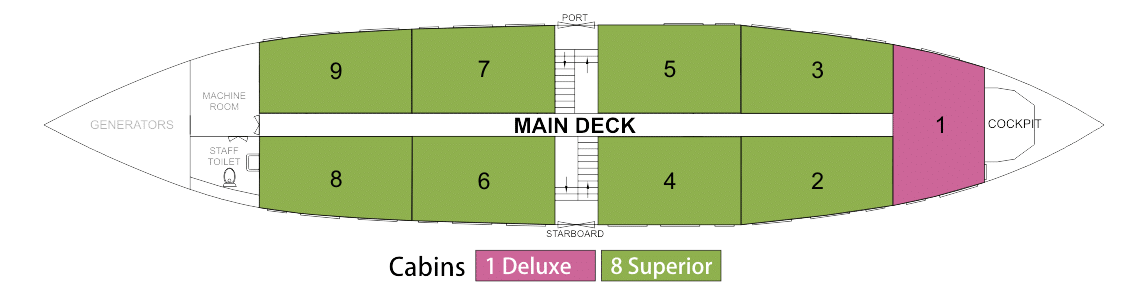
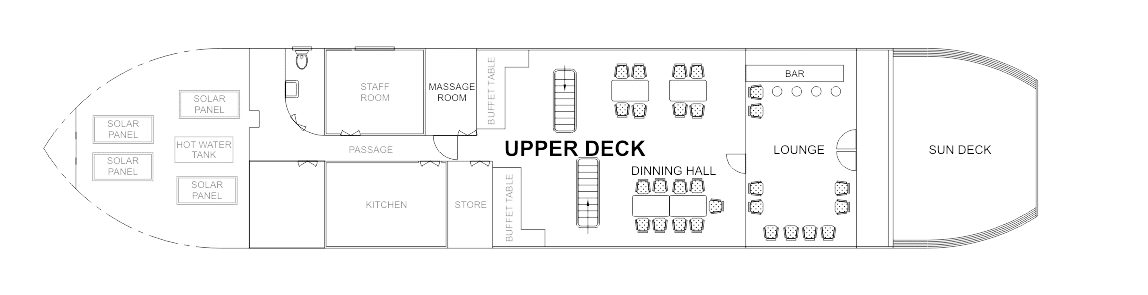
MV Vaikundam has nine well-appointed cabins with attached bathrooms on the lower deck and, a well-functional kitchen, air-conditioned and exquisitely set dining hall and open lounge on its upper deck.
Vaikundam is a modified version of the traditional Kettuvallom or rice barges of the past. The rooms are made using wooden panels, bamboo poles and bamboo mats, following the traditional practices but contain all modern amenities.
The wooden hull of the boat is made by joining planks of local wood ‘Aanjili,’ using strong coir rope on the segments above the waterline. The wood is coated with a caustic black resin made by boiling cashew kernel and fish oil. The wood is periodically treated with the Neem oil and Fish oil.
Ship Profile & Stats
- Passenger Capacity (dbl): 18
- Dining Staff Nationality: Indian

When you are in India, you need to explore places that India is proud to put on the map! The luxury cruises along the beautiful, holy and historic Brahmaputra River and Kerala Backwaters offer you a chance to discover the enchanting countryside, the villages, the exotic wildlife and the famous Indian Dolphins of Brahmaputra River. The exotic river life found on the beds of the Brahmaputra will leave you in awe.
To get to really know Kerala, one must first understand her waterways – the lifeline of the entire region. There’s no better way to enrich oneself than to truly comprehend the life of the people of the land. And what better way to visit them at close quarters than in awe-inspiring river cruise boats – it’s like having a moving home on the water!
Select the Deck to view detail.
Select the Cabin to view detail.
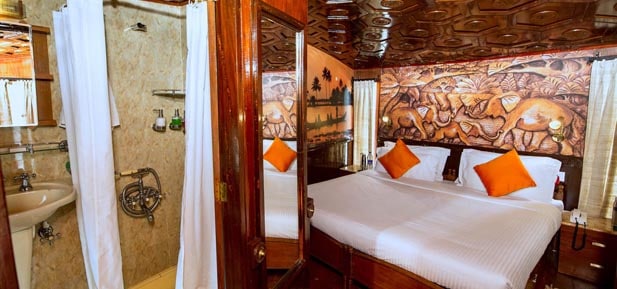
140sqft
Bathroom
Windows on 3 Sides
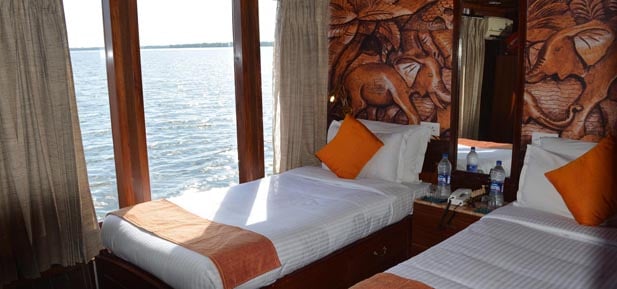
130sqft
Bathroom
Windows on 1 Side
* Unless otherwise noted all pricing is on a per person twin share basis. All prices based on cash payment - credit card fees may apply. Cruise deposit, amendment and cancellation conditions apply. Special conditions may apply - please ask for full details at time of enquiry. All passports, vaccinations and visas are the responsibility of the travelling guest to secure prior to departure from Australia. Any pricing not in Australian Dollars will be converted on the day of payment into the relevant currency based on our daily rate of exchange. Please note that many of the prices shown on this website are not shown in real time. Whilst we endeavour to keep our pricing as up-to-date as possible, the advertised prices shown here may differ slightly from the live prices in our booking system. All pricing and offers are subject to availability at time of booking. Whilst all information is correct at the time of publication, offers are subject to change. We reserve the right to correct errors without penalty. Please submit any data errors/omissions you may notice on this site.
Unless otherwise expressly noted, all materials, including images, illustrations, designs, icons, and photographs appearing anywhere on this website are protected by worldwide copyright laws and treaty provisions. The copyright on such materials is held by the original creator of the materials. None of the materials may be copied, reproduced, displayed, modified, published, uploaded, posted, transmitted or distributed in whole or in part in any form or by any means other than as provided by Cruise Factory and Cruise Traveller to its clients, or with the prior written permission of Cruise Factory and Cruise Traveller. All rights not expressly granted in these Terms are reserved. Any unauthorised use of the materials appearing on this website may violate copyright, trademark and other applicable laws and could result in criminal or civil penalties.